Island Guides · checked 2026-08-13

Where to learn lei making on Oʻahu

15 places that teach it, 3 of them free and open to anyone — with what each one actually teaches, who is allowed in, and the difference between a technique and a place on your body.

First, the thing nearly every guide gets wrong

A flower crown is widely called a haku lei. That is not quite right, and it is worth thirty seconds of your time before you book anything.

Haku is a verb. It means to braid. It describes how a lei was made, not where it is worn. A lei worn on the head is a lei poʻo, whatever technique produced it. And most flower crowns made today are not braided at all — they are wili, wound onto a base, because that is faster and holds better.

So “haku lei” for a flower crown is imprecise on two counts. It is also completely normal usage in Hawaiʻi — you will hear it from florists, from photographers, and from Native Hawaiian practitioners. This confusion grew up here; it is not something visitors imported.

Nobody is going to correct you. But if you ask for a lei poʻo workshop and want it braided rather than wound, say haku and you will be understood exactly.

The techniques, and what each one means

NameMeansWhat it is
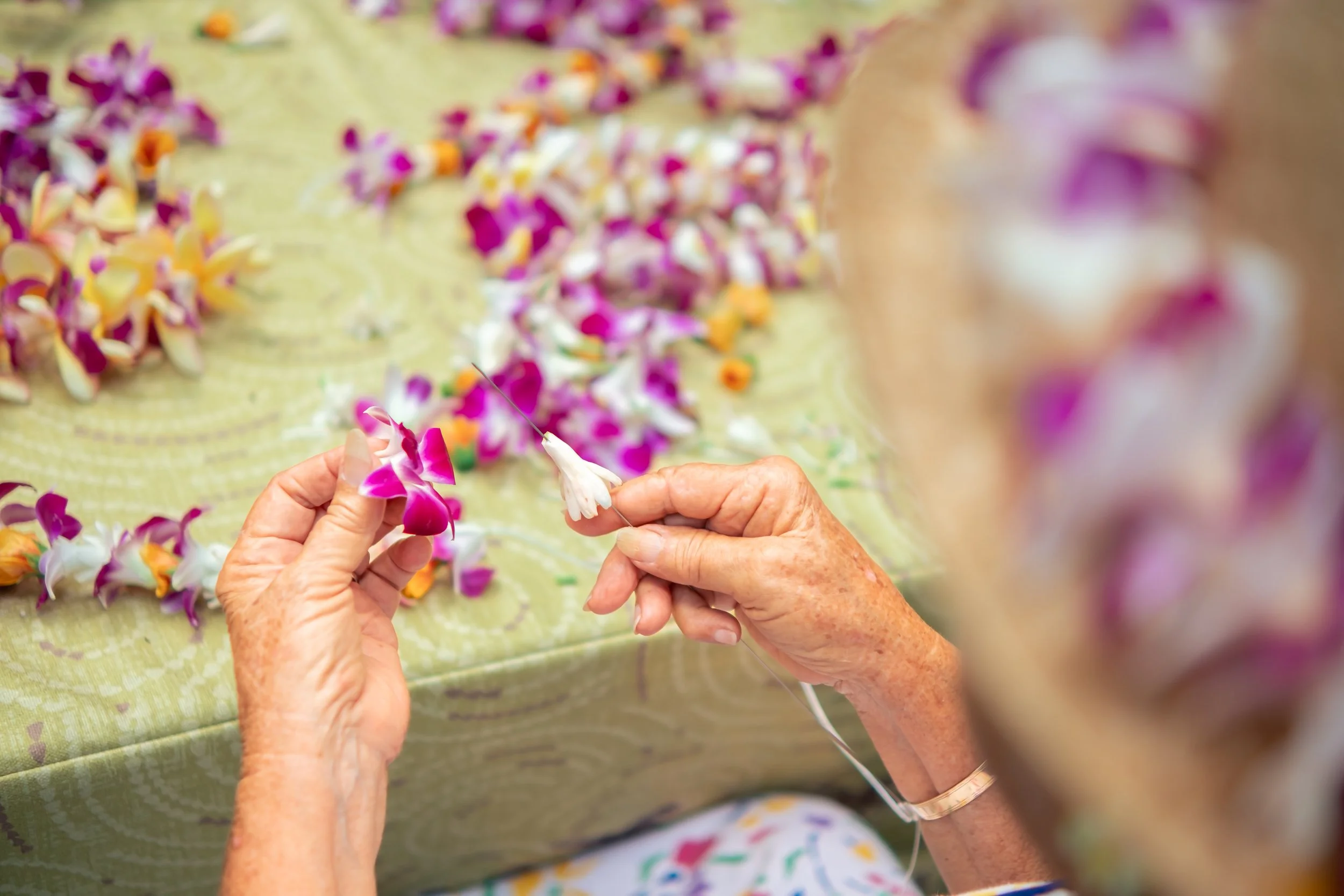
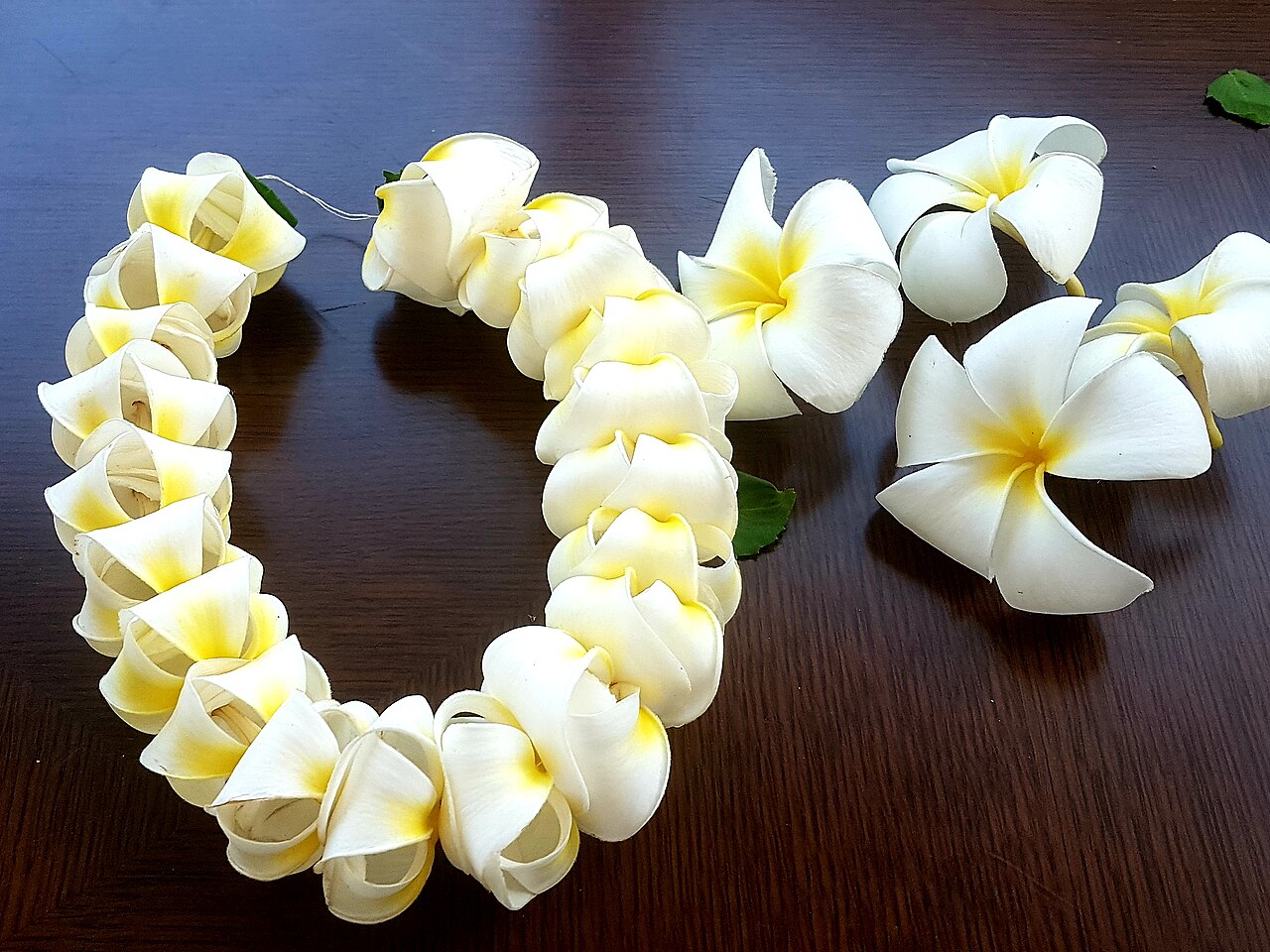
kuito pierce, to stringFlowers are pierced and threaded onto a long needle. This is the one everybody pictures.Plumeria, pīkake, pakalana, tuberose, ginger — the classic lei you are given at the airport.
wilito windMaterial is wound onto a base with raffia, lāʻī or thread. Nothing is pierced and nothing is braided. Durable, versatile, and what most modern head lei actually are.Most lei poʻo you will see at a graduation or a wedding.
hakuto braidA genuine three-strand braid, with at least two kinds of flower material worked into it as you go. Slower and harder than wili.Mixed flower-and-fern head lei made by actual braiding.
hilito braid or plaitBraided like haku, but from a single material braided on itself, with no separate base.Maile, palapalai, kaunaʻoa.
humu, humupapato sew onto a baseMaterial is sewn flat onto a backing — papa means a flat surface. This is how feather work is mounted.Lei hulu on a hat band, and the lei worn by pāʻū riders.
hīpuʻu, kīpuʻuto knotStems are overlapped and knotted to one another. No needle, no base, no braid.Lau kukui — kukui leaves — and some lāʻī work.
hiloto twistTwo strands twisted into a rope.Lei lāʻī, the twisted ti leaf lei.

One more small thing, since we are here: lei is not pluralised. One lei, two lei, a table of lei. Hawaiian nouns do not take an s.

Free, and open to anyone

The best free lei making on this island is not in a hotel. It is in a shopping centre in Waikīkī and a public library in Nānākuli, both taught properly, both free, and neither requiring you to be a guest of anything.

Royal Hawaiian Center — kui — orchid lei, Oʻahu

🌺 Royal Hawaiian Center

Instruction

Free

2201 Kalākaua Avenue, Building C Level 2, Honolulu, HI 96815

Fridays, 11:30am–12:30pm

Technique.
kui — orchid lei
Open to.
Everyone. Not just shoppers, not just hotel guests.
Booking.
No reservations. First come, first served, and capped at the first 24 people.
You take home.
The orchid lei you strung.

The single best free option in Waikīkī, and properly taught — the basic skills, the technique, the preparation. The same centre runs free lauhala weaving on Wednesdays at the same time and place, so a Wednesday and a Friday gets you two crafts for nothing.

Before you go. A large travel site publishes a different schedule for this centre — Tuesday, in the Royal Grove. That is wrong. The centre’s own page says Friday, Building C, Level 2.

(808) 922-2299 · Their page · checked 2026-08-13

Free, and all supplies are included

89-070 Farrington Hwy, Waiʻanae, HI 96792

5:30pm–7:00pm. It recurs, but the library publishes no fixed cadence — the branch page lists whatever is next.

Technique.
wili
Taught by.
Kahi Barrett Keyes of Kaleipuupuu
Open to.
Recommended for teenagers and adults.
Booking.
Not stated. Accessibility accommodations with 48 hours notice.
You take home.
Your lei.

Free instruction in a named traditional binding technique, taught by a working artist, with the materials found for you — and almost nobody outside Waiʻanae knows it exists. The state library system also runs episodic lei workshops at other branches, including ti leaf and lei poʻo sessions with Samantha Sun of the City’s Parks and Recreation culture staff. Those rotate, so work from the branch page rather than trusting a fixed date.

Before you go. The library builds a separate web page for every single occurrence of this club, each on a URL ending in a string of numbers, and each one says “this event has passed” the day after it runs. We link to the branch page on purpose: it survives, and it shows whatever is next. If you find a dated page for this club through a search engine, check the year before you drive to Waiʻanae.

(808) 668-5844 · Their page · checked 2026-08-13

🏬 International Market Place

Make and take

Free, while supplies last

2330 Kalākaua Ave, Level 1, Queen’s Court, Honolulu, HI 96815

Third Thursday of the month, from noon

Open to.
Open to the public.
Booking.
No RSVP. First come, first served.
You take home.
Your lei.

An interactive workshop in the Queen’s Court. The technique is not named in anything they publish.

Before you go. This is the shakiest entry on the page. The most recent primary documentation we could find is a 2024 tourism-board advisory, the centre’s own events page is closed to us, and two sources disagree on whether it finishes at 1pm or 2pm. Ring before you plan around it.

(808) 931-6105 · No website · checked 2026-08-13

Free, but you have to be staying there

Resort cultural programmes, which range from real orchid kui instruction to a kukui nut craft table. We have said which is which rather than listing them all as "lei making". Almost none publishes a price, and almost none says whether non-guests may join.

Publishes no price

5000 Kāhala Ave, Honolulu, HI 96816 — classes on The Veranda

Lei making Fridays and Sundays 10–11am · lei lāʻī (ti leaf) Saturdays 9–10am · haku kupeʻe, the raffia bracelet, Thursdays 9–10am

Technique.
Flower lei, lei lāʻī, and a raffia kūpeʻe
Open to.
Not stated anywhere — ask.
Booking.
Reservations required for the ti leaf class, and required by 8am on the morning for the kūpeʻe class.
You take home.
A flower lei, a ti leaf lei or a woven bracelet, depending on the day.

Three genuinely different classes across the week, which is more than any other hotel here offers, and the kūpeʻe session is a technique you will not find elsewhere on a resort calendar.

Before you go. A local magazine reported these as free and open to the public with no reservation needed. The hotel’s own calendar now says reservations are required for two of the three, and publishes no price at all. We are not printing a figure or an access claim until someone rings 808-739-8604 and asks.

(808) 739-8604 · Their page · checked 2026-08-13

Complimentary for registered resort guests

57-091 Kamehameha Highway, Kahuku, HI 96712 — in the lobby

Mondays, Wednesdays and Fridays, 9–10am, all through 2026

Technique.
kui — orchid lei, 42 flowers
Open to.
Registered guests. The resort publishes no non-guest rate.
Booking.
Reservations highly recommended, through the resort activities desk.
You take home.
One orchid lei, forty-two flowers.

Called ʻOkika Creations — ʻokika is orchid. Three mornings a week, dated on the resort’s own calendar right through to the end of the year, which is more certainty than most entries here offer.

Before you go. A $50 non-guest price circulates widely and is contradicted by the resort’s own current page, which offers no non-guest option at all. Do not turn up expecting to pay in.

Their page · checked 2026-08-13

Complimentary

Aʻo Cultural Center, in the resort lobby, Waikīkī

Lei making Monday 10am, Thursday 10am and Saturday 9am · ti leaf kūpeʻe Tuesday 9am and Friday 10am · kukui kūpeʻe Wednesday 2pm and Saturday 1pm

Technique.
Flower lei and kūpeʻe
Open to.
Listed under guest activities.
You take home.
Your lei or bracelet — except on Thursday lunchtime.

The most frequent hotel programme on the island, and one session stands apart: on Thursdays from noon the lei you make is taken to the Duke Kahanamoku statue and left there. You do not keep it. That is the point, and it is the only session of its kind on this page.

Their page · checked 2026-08-13

🥥 Hilton Hawaiian Village

Make and take

Publishes no price

Tapa Concourse, 2005 Kālia Rd, Honolulu, HI 96815

Kukui nut lei Mondays and Fridays at 1pm and 2pm · bracelets Tuesdays and Thursdays · key chains Wednesdays

Open to.
Hotel guests, via the Activities Card.
Booking.
Present your Activities Card.
You take home.
A kukui nut lei, bracelet or key chain.

Worth being straight about: this is kukui nut craft, not fresh-flower lei practice. It is a nice hour and it is not the same thing. If you want flower lei for free and without being a guest, go to Royal Hawaiian Center instead.

Their page · checked 2026-08-13

Lei hulu — feather work

The thinnest and most fragile category on this page, and the guide should say so plainly. Feather work was aliʻi material — the historic birds are extinct or protected, and modern practitioners work in pheasant and dyed chicken feather. There is one teacher we can verify.

Publishes no price

904 Kohou St, Suite 204, Honolulu, HI 96817

Ongoing monthly classes, plus private sessions and half or full day workshops — none of it on a published timetable

Technique.
Lei hulu — haku hulu, wili hulu and humupapa
Taught by.
Kumu Hulu Mele Kahalepuna-Chun, carrying the Kekuewa family lineage
Open to.
Individuals, small groups, hālau and organisations.
Booking.
Call ahead. Everything here is arranged rather than booked.
You take home.
Your feather work, and rather more than that.

This is the lineage source for Hawaiian featherwork on this island — the shop of the late Aunty Mary Louise Kekuewa and Paulette Kahalepuna, now carried on by their family. They sell feathers as well as teach, and they run short introductory pua hulu sessions as well as serious work. If one entry on this page is worth a phone call rather than a click, it is this one.

Before you go. Their own site says there are ongoing monthly classes. It publishes no dates, no prices and no age limits. We are not filling those in from anywhere else.

(808) 499-7048 · Their page · checked 2026-08-13

$60 for the workshop, $25 for the kit

4369 Lawehana Street #A2, Honolulu, HI 96818

Whenever you like — six months of viewing access

Technique.
Lei hulu
Open to.
Anyone.
Booking.
Bought online.
You take home.
Your feather lei, made at your own table.

Listed here because it is filed under "workshops" and people book it expecting to turn up somewhere. It is recorded video, not a class in a room. As a way to learn lei hulu at home with the right materials to hand it is genuinely good, and the same shop sells the feathers.

(808) 847-7600 · Their page · checked 2026-08-13

Lei Day, 1 May

Don Blanding of the Honolulu Star-Bulletin proposed it in 1927; his colleague Grace Tower Warren picked 1 May and coined the line "May Day is Lei Day in Hawaiʻi". The first celebration was 1 May 1928, in the lobby of the Bank of Hawaiʻi, with a lei contest judged by Princess Abigail Campbell and Elizabeth Lahilahi Webb, who had been lady-in-waiting to Queen Liliʻuokalani. Territorial recognition followed in 1929.

The island flowers and colours predate Lei Day — they were set by a 1923 territorial resolution, which is why the very first contest was judged on using them correctly. Oʻahu is melemele, yellow, and pua ʻilima. A lei ʻilima takes hundreds of blossoms, which is why you rarely see one.

The Lei Day Celebration at Kapiʻolani Park runs all day on 1 May, free — the Royal Hawaiian Band, the Lei Court investiture, hālau hula at the bandstand, the juried lei contest on public display, and lei makers demonstrating in the Kūlana Lei Village. After the closing ceremony the contest lei are taken and placed at cultural sites, which is the detail that separates it from a craft fair.

Around it, Ward Centre has run a free hands-on lei workshop on the Saturday, materials provided. Several paid Lei Day events are concerts or contests rather than classes — read the listing before you buy a ticket expecting to make something.

Where to get materials

  • Aloha Hula Supply, 4369 Lawehana St #A2 — feathers, lei hulu kits, raffia, shells and artificial components. The main feather source on the island.
  • Nā Mea Hawaiʻi / KĪPUKA, Ward Centre, 1200 Ala Moana Blvd — cultural tools and materials, in store only.
  • PALAI — raffia, lei kits and floral pruners, collected at Kākou Collective in ʻAiea or at makers markets, with 10% off if you have booked a workshop.
  • Cindy’s Lei & Flower Shoppe, 1034 Maunakea St, Chinatown — loose flowers by the bag. Open from 7am.
  • Watanabe Floral, 1618 N Nimitz Hwy — a large local florist and a practical source of fresh material, though their own classes are currently paused.
  • Farm Link Hawaiʻi — the route to locally grown flowers rather than imported ones, which matters more than it sounds: most lei sold in Hawaiʻi are now strung overseas from imported blooms.

More detail on all of these in where to buy craft supplies on Oʻahu.

Before you pick anything yourself

This is the section other guides skip, and it has real legal content in it.

  • Collecting plant material in a Hawaiʻi State Forest Reserve requires a permit, even for personal use, even for one lei. The permit is free for personal quantities, you apply about ten working days ahead, and you may only hold one in any seven-day period.
  • Endangered and threatened plants are never permitted. On Oʻahu the permitted list covers non-native fern fronds, maile from certain reserves, and some greenery — note "non-native" for ferns, which rules out palapalai.
  • Do not gather ʻōhiʻa lehua or liko at all. The state has suspended all ʻōhiʻa collection in forest reserves because of Rapid ʻŌhiʻa Death, and a permanent interisland quarantine makes it illegal to carry ʻōhiʻa material — including a finished lehua lei — from Hawaiʻi Island to Oʻahu.
  • Maile is legal from certain reserves with a permit and is under real pressure, with growers describing people pulling vines up by the roots. Cultivated maile is the ethical option, and increasingly the only available one.
  • The old protocol is simple and still holds: ask before you take, take only what you need, never uproot. The ʻōlelo noʻeau is E ʻai i ka mea i loaʻa — use what you have.

Giving, wearing, and letting go

Some of what circulates as ancient Hawaiian tradition is in fact twentieth-century custom, and some of it we simply could not trace. We have marked which is which, because a guide that dresses up living practice as ancient law is not being respectful, it is being careless.

How is a lei actually given?

The drape-over-the-head-and-kiss is a twentieth-century steamship and tourism custom, not the older Hawaiian one. Traditionally the giver bowed and held the lei out for you to take, because the head is sacred and reaching over it was disrespectful. Both happen constantly in Hawaiʻi today and nobody will mind either — but the older way is the one worth knowing.

Is it rude to take a lei off in front of the person who gave it?

Living practice

It is considered discourteous, and refusing one outright is worse. Treat this as contemporary courtesy rather than ancient rule — it is taught everywhere in Hawaiʻi, and we could not trace it to any museum, dictionary or university source.

What about pregnant women and closed lei?

Living practice

Many people in Hawaiʻi observe this: a pregnant woman is given an open, untied lei rather than a closed circle. It is live, current practice and worth respecting. We are not going to tell you it is an ancient tradition, because we searched for it in the standard cultural sources and did not find it there.

How do you throw a lei away?

You do not. A lei is returned to the earth — untie it, strip out the string, wire and ribbon, and compost it, bury it or hang it in a tree. Ignore the line about throwing it into the sea to guarantee your return; that is a tourism-era saying, and a modern lei is full of plastic and non-native flowers.

Is it alright to give a lei you did not make?

Completely. Buying from a lei seller is a deep and multigenerational Hawaiʻi practice with its own lineages, and the lei sellers on Maunakea Street are part of the culture, not a substitute for it. A handmade lei carries extra weight, which is a different point. Aunty Nona Beamer taught it as: make a lei, wear a lei, give a lei.

Real, but we could not verify enough

Each of these teaches lei, or says it does. None had enough published for us to put a time or a price against it, so they are here rather than above.

  • Bishop Museum. Their site will not open to us at all, and they are the institution most likely to be teaching lei hulu and the history of lei properly. Two relevant page titles exist in search results — a Living Culture engagement on the art and significance of lei, and a lei hulu humupapa series with Kawika Lum-Nelmida — but the most recent date we could attach to the series is 2023. We will not publish a museum programme from a search snippet. Ring them.
  • Moana Surfrider. A recurring event titled "Lei Making" appears on the resort’s own calendar, but with no day, time, price or guest policy published anywhere we can read.
  • Waimea Valley. Their artisan page lists Kawika Pangelinan offering Hawaiian language, instruments and lei, hands-on. No day, time or price is published, and artisan presence looks rotational.
  • PoeHaku Flower Bar in Lāʻie. Real, teaching lei wili, and booked entirely through a third-party experiences platform — so their own site publishes no price, duration or group size.
  • A lei class sold at Sunset Beach through a city pass, Monday to Friday at 10am, up to $50, booked 24 hours ahead. The listing does not name the company running it, and we could not identify them.
  • Hyatt Regency Waikīkī, the Royal Hawaiian, Sheraton Waikīkī, Princess Kaʻiulani and the Waikīkī Beach Marriott. An aggregator lists lei or ribbon sessions at all of these. None of the hotels publishes one on its own site, so we are not repeating it — and note that ribbon lei is a craft activity, not flower lei.

Paused, or quietly stopped

None of these is confirmed closed. Each is confirmed not currently advertised, which is a different and more careful claim.

  • The City and County Parks and Recreation free pre-Lei-Day workshop programme — twenty-two free workshops in 2019, and we can find no announcement for any year since 2020. The department’s culture staff still teach lei at libraries, so the capability is there; the branded programme appears dormant.
  • Watanabe Floral haku lei workshops — their own classes page now reads "coming soon", with no dates or registration.
  • Lulu’s Lei + Bouquets in Haleʻiwa, listed at $95 in 2025 — their current site carries no workshop content at all.
  • Mean Woman Flower Farm lei poʻo workshops — no workshop page on any current channel; they now sell finished lei through Farm Link Hawaiʻi.
  • Ka Pā Hula O Kauanoe O Waʻahila lei hulu workshops with Kumu Hulu Mele Kahalepuna-Chun — last dated 2024, registration closed.

Ranks for Oʻahu, is not on Oʻahu

Haliʻa Ola

Kailua-KONA, on Hawaiʻi Island. The name collision with Kailua on Oʻahu is what makes this the most dangerous one. Their own surcharge is measured from Kailua-Kona.

Mōhalu Hawaiʻi

Waimea, Hawaiʻi Island.

Haku Maui

Makawao, Maui.

Coconut Marketplace cultural classes

Kapaʻa, Kauaʻi.

Hilton Waikoloa Village activities

Hawaiʻi Island. Very easily confused with Hilton Hawaiian Village in Waikīkī, which is a different hotel on a different island.

flowerleis.com "lei making classes"

A lei shipping company’s content page. It runs no classes at all — it links out and sells kits. It ranks well, which is the problem.

How this was checked

Every class here came off the venue’s own page, checked on 2026-08-13. The technique names come from Kamehameha Schools and the Leeward Community College library rather than from travel writing, and every ʻokina and kahakō on this page was set deliberately — kūpeʻe and pīkake carry marks that are almost universally dropped.

We have split the classes three ways, because the word “lei making” is doing very different jobs on different hotel calendars. Instruction means a practitioner teaches you a named technique. Make and take means hands-on, but the framing is souvenir — kukui nut and ribbon sessions sit here. They are a pleasant hour and they are not the same thing, and lumping them together would have made this page useless.

Two things we found and did not print. A $50 non-guest rate at Turtle Bay circulates widely and is contradicted by the resort’s own current page. And Bishop Museum — the institution most likely to be teaching lei hulu and the history of lei properly — will not open to us at all, so nothing about it appears above on the strength of a search result.

Where a venue names the person teaching, we have named them too. Attribution is the clearest signal that a guide has done the work, and lei making is taught here openly and gladly — Aunty Nona Beamer’s teaching was make a lei, wear a lei, give a lei. It is an invitation, not a closed practice.

If we have a technique, a name or a diacritical wrong, that matters more here than anywhere else on this site. Tell us and we will fix it.